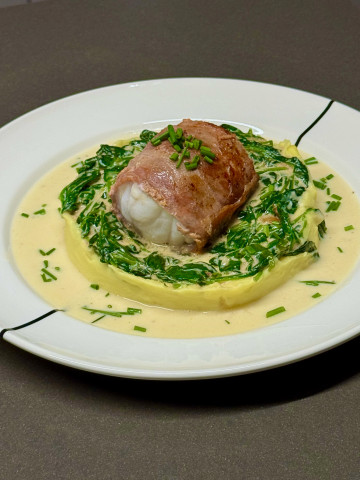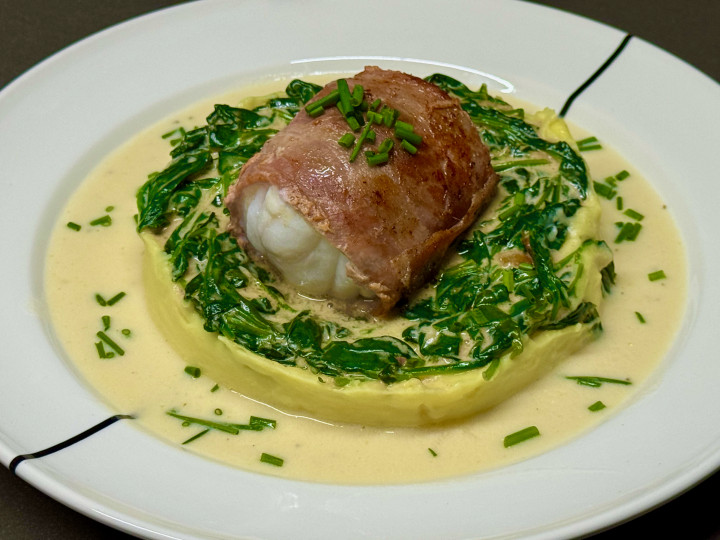
Monkfish saltimbocca is one of those dishes that blends elegance and comfort with effortless grace. The firm, almost butter-soft fish is wrapped in sage and pancetta, giving it the feel of a Mediterranean classic dressed for an evening out. It's served with creamy spinach and a velvety potato mousseline that together make the whole plate feel like a warm welcome on a winter night. And finally, a white-wine sauce brings everything together with a light, festive sheen.
Because this dish brings together several culinary concepts, we'll guide you through it step by step. We'll explore what makes monkfish so special, explain where the name saltimbocca comes from, and show how potato mousseline differs from ordinary mashed potatoes. But first: let's savour the promise of a true celebratory meal.

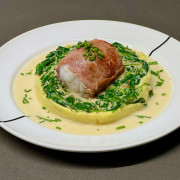
Monkfish saltimbocca
Ingredients
For the monkfish saltimbocca
- 600 grams monkfish fillet
- 16 leaves sage
- 12 slices pancetta
For the creamed spinach
- 200 grams baby spinach
- 100 ml cooking cream
- 25 grams grated Parmesan
- 2 cloves garlic
For the potato mousseline
- 500 grams potatoes peeled
- 100 ml milk
- 100 ml heavy cream
- 50 grams butter
For the white wine sauce
- 3 stalks celery
- 2 dl white wine
- 2 dl fish stock
- 2 dl cooking cream
- 2 bay leaves
- 1 onion
- 1 teaspoon dried thyme
Instructions
Preparing the white wine sauce
- First, finely chop the celery stalks and the onion.
- Now melt the butter and sauté the celery and onion in it.
- Then add the white wine and let it reduce almost completely.
- In the meantime, you can also add the bay leaf and thyme to the sauce base.
- Finally, add the fish stock and the cream to the base. Let this simmer and reduce for about ten minutes.
- Now strain the vegetables from the sauce to create a smooth sauce. Season with salt and pepper to taste.
- Set the white wine sauce aside or keep it warm.
Preparing the potato mousseline
- Peel the potatoes, cut them into pieces, and steam or boil them until they are cooked through.
- Mash the potatoes with a potato masher. Then push them through a sieve again. We want an extra-fine puree.
- First, mix the butter, then the milk and cream into the puree until you have a nice, smooth mousseline.
- Keep it warm in the oven.
Preparing the creamed spinach
- Crush the garlic cloves with a paring knife and then finely chop them.
- Melt the butter in a pan and briefly sauté the baby spinach until it melts. (Tip: use the warm pan you used to sauté the saltimbocca).
- Now add the cooking cream and grated Parmesan to the spinach.
- Let everything reduce and integrate.
Preparing the monkfish in saltimbocca
- Place the sage leaves on the monkfish fillets and then wrap them in the saltimbocca.
- Wrap the monkfish in saltimbocca in cling film and refrigerate for 24 hours.
- Preheat the oven to 180°C (350°F).
- Heat the butter in a pan until bubbling. Then briefly sear the pancetta-wrapped monkfish on all sides.
- Then place the monkfish in saltimbocca on a baking sheet lined with parchment paper. Cook for another four minutes in a preheated oven at 180°C (350°F).
Serving the monkfish saltimbocca
- Place the silky potato mousseline in a ring in the center of each plate.
- Then spread the creamed spinach over the potato mousseline.
- Place the monkfish in saltimbocca on the bed of spinach and mousseline.
- Spoon the white wine sauce around the potato mousseline on the plate.
- Garnish with some finely chopped chives, if desired.
Nutrition
How to make monkfish saltimbocca?
For this monkfish saltimbocca, you'll need four different components: the white-wine sauce, the potato mousseline, the creamy spinach, and of course the monkfish saltimbocca itself. It may sound like a lot of work, but it's very manageable. There's not much chopping involved, and several components can be prepared well in advance.
Preparing the white-wine sauce
We start with the white-wine sauce, which you can easily make ahead of time. Before serving, you'll only need to warm it up.
The sauce uses celery stalks and an onion, so we begin by finely chopping those. Trim the ends off the celery stalks. Rinse them thoroughly if needed to remove any sand. Halve them lengthwise, then cut them into small pieces. Remove the tough skin from the onion and chop it as well.
Melt some butter in a small saucepan until it foams. Add the celery and onion, and sauté them for a few minutes. When they turn translucent and release their aroma, deglaze with white wine. Let the wine reduce almost completely so the alcohol evaporates and the flavours concentrate. Add the bay leaves and dried thyme.
Now add the fish stock and the cooking cream. Bring the sauce to a boil, then let it simmer and reduce for about ten minutes.
Finally, strain out the vegetables and herbs. You now have a smooth, flavourful white-wine sauce. Season to taste with salt and pepper.
Keep the sauce warm while you prepare the rest of the dish. If you're working ahead, let it cool and store it in the fridge.
Preparing the potato mousseline
For the potato mousseline, we naturally start with potatoes. Peel them and cut them into medium-sized pieces. Then boil or steam them (I prefer steaming) until they're fully tender. They should mash easily.
Next, press the potatoes through a sieve. It's a bit more work, but it's the key step that sets mousseline apart from regular mashed potatoes - more on that later.
Now we can finish the potato mousseline. First, mix butter into the fine potato purée. Once it's fully incorporated, add the milk and heavy cream. Combine everything into a light, silky potato mousseline.
Keep it warm while you prepare the remaining components.
Preparing the monkfish saltimbocca
The small amount of prep for the monkfish saltimbocca actually starts a day in advance. We let it rest in the fridge for 24 hours, or at least overnight.
Lay out the slices of pancetta so they overlap slightly. Place the monkfish fillets on top and press the sage leaves into the fish. Then roll the monkfish up in the pancetta. Wrap the rolls tightly in cling film and let them rest overnight in the fridge.
Heat some butter in a pan and remove the monkfish from the cling film. Cut it into the portions you want. Preheat the oven to 180°C and line a baking tray with parchment paper.
Sear the monkfish saltimbocca over high heat until golden on all sides. Transfer the pieces to the baking tray and let them finish cooking in the oven for about four minutes.
Preparing the creamy spinach
The last component we need to prepare is the spinach - and that's very quick.
Crush the garlic cloves with the side of a chef's knife. Remove the skins and chop the garlic finely. Sauté it briefly in some butter in the still-warm pan you used for the monkfish.
Add the baby spinach to the pan. It will look like a lot, but it wilts quickly. Then add the cream and grated Parmesan. Stir everything together and let the cream reduce slightly.
Serving the monkfish saltimbocca
Now we simply bring all the components together on the plate. If you have a cooking ring, it's very handy here.
Start with the potato mousseline, placing it neatly in the centre of the plate using the ring. Spoon the creamy spinach on top.
Place the monkfish saltimbocca on the bed of mousseline and spinach - the star of the dish.
Finally, spoon the white-wine sauce around the mousseline. Finish with a sprinkle of finely chopped chives.
What is monkfish?
As elegant as monkfish looks when it arrives on your plate, that's how monstrous it appears in its whole form. It has a large, flat head with a wide mouth and sharp teeth. You don't eat that head: in the kitchen, only the firm tail meat is used. As a result, at most two-thirds of the fish is usable - sometimes even less, because the head makes up such a large part of its body.
Monkfish lives in the Eastern Atlantic Ocean, from the coasts of Africa all the way to the far north. You'll also find it in the Mediterranean Sea and the North Sea, where it lives on the seabed at depths between 15 and 1000 metres.
It's a firm white fish with beautiful, compact fillets, which makes it highly prized in gastronomy. The flavour is mild, almost lobster?like, and the flesh stays wonderfully firm when baked or poached.
Read more about monkfish in the following articles:
- Lophius - Wikipedia.
- What is monkfish? (The spruce eats).
- Monkfish, the poor man's lobster (Luke's lobster).
- Everything you need to know about... monkfish (Fresh fish daily).
What Is Saltimbocca?
If it sounds Italian, is easy to make, and tastes wonderful, it ís for sure Italian. Saltimbocca is a classic preparation in which thin slices of meat - traditionally veal - are topped with prosciutto and sage. You roll or fold them, sear them briefly, and serve them with a light, flavourful sauce. The result is so irresistible that it practically "jumps into your mouth." And that is quite literally what the name means.
Originally, it's a Roman dish: saltimbocca alla Romana. From there, it spread throughout Italy and later across Europe. Today, countless variations exist with chicken, pork, and even fish - like in this recipe, where the classic technique pairs beautifully with monkfish.
Read more about saltimbocca in the following articles:
- Saltimbocca - Wikipedia.
- Saltimbocca alla Romana and their controversial origins (Quarta hospitality).
- The unmistakable Italian taste: Saltimbocca alla Romana (Eat and walk Italy).
What Is potato mousseline?
Potato mousseline is an ultra-fine, airy purée made not by mashing cooked potatoes, but by pressing them through a sieve or food mill. You then enrich it with warm milk, cream, and butter, which gives it its silky texture. The result is lighter than classic mashed potatoes, yet fuller and more elegant in flavour.
What makes it different from regular mash?
- Texture: Mousseline is much finer and lighter. No lumps, no graininess - just velvet.
- Fat content: The addition of cream and extra butter gives it a rich, almost creamy mouthfeel.
- Technique: The potatoes aren't crushed but rubbed through a sieve, creating that refined structure.
- Character: Mash is comfort food; mousseline is comfort food dressed for the evening.
What does it pair well with?
Potato mousseline is ideal for dishes that benefit from a touch of elegance: fish, poultry, delicate sauces… and therefore perfect with your monkfish saltimbocca, where it becomes the creamy, gentle counterpart to the savoury prosciutto and bright white-wine sauce. Where the saltimbocca, so to speak, jumps into your mouth, the potato mousseline glides in softly.
Read more about potato mousseline in the following article:
More surprising.fish
Fish lends itself beautifully to festive and surprising dishes that don't sit too heavily on the stomach. Be sure to gather even more inspiration from the following recipes:
- Delicious seafood fricassee.
- Scallops with blood sausage.
- Fish casserole with tomato-apple sauce.
- Fish stew with asparagus.
- Octopus in red wine sauce.
If you speak Dutch, you can find the Dutch version of this recipe on gerechtenweb.blog.